
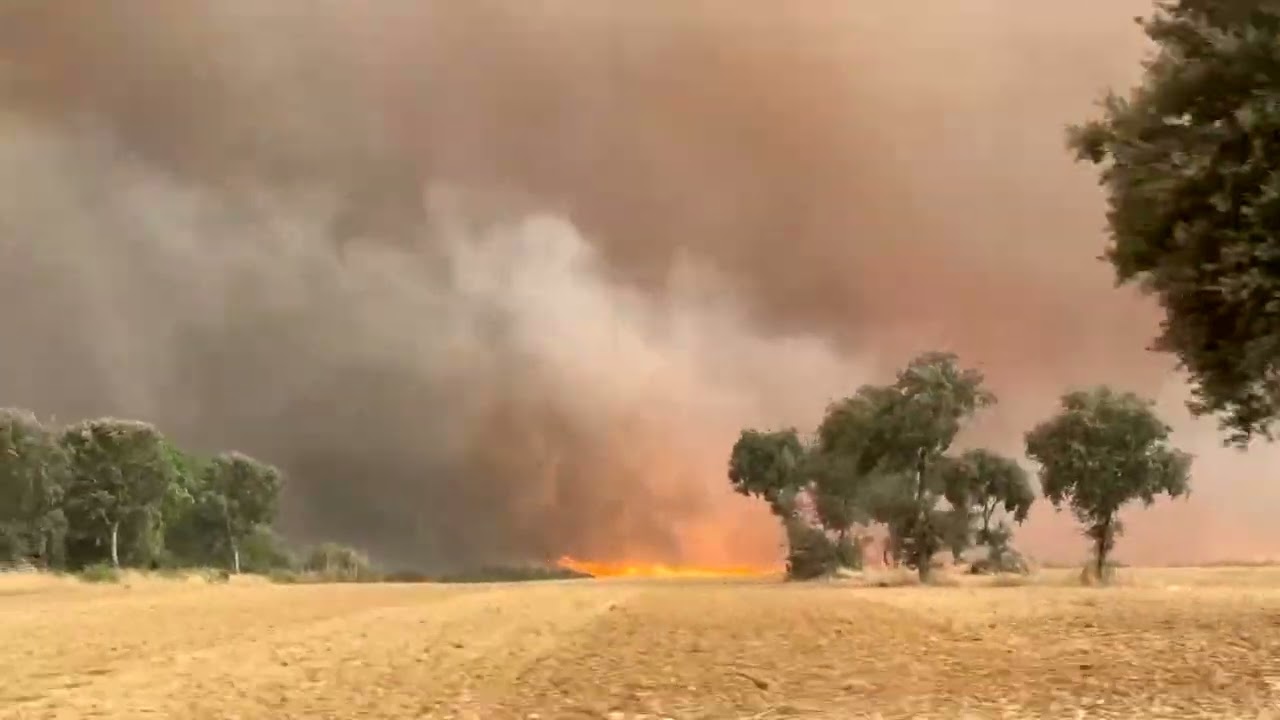
Rapidly spreading wildfires fueled by record low humidity and sustained winds of up to eighty kilometers per hour have forced the evacuation of more than two hundred thousand residents across southern Spain, Portugal, and Greece this weekend, stretching emergency services to their limits and prompting requests for aerial firefighting assistance from neighboring nations and the European Union’s civil protection mechanism.
The fires broke out nearly simultaneously across multiple ignition points on Friday evening under conditions that meteorologists described as a perfect convergence of drought-parched vegetation, an early heat wave delivering temperatures fifteen degrees above seasonal averages, and an unusual katabatic wind pattern pushing dry air down from inland mountain ranges toward densely populated coastal zones. Fire behavior specialists warned that such conditions allow flame fronts to advance at speeds that outpace traditional containment strategies, requiring aerial suppression as the primary tool rather than a supporting resource.
In the Algarve region of Portugal, entire hillside villages were abandoned overnight as fire lines approached within kilometers of populated areas. Portuguese authorities activated their highest national emergency level for the first time since 2017, deploying military units to assist civilian evacuation and establishing emergency shelter facilities in sports arenas and convention centers along the coast capable of housing displaced residents for extended periods.
Spain’s Andalusia region declared a regional state of emergency as fires consumed tens of thousands of hectares of protected natural park land, threatening ecosystems that took decades to recover from earlier burn cycles. Greek authorities were simultaneously managing separate fire fronts in the Peloponnese and on the island of Rhodes, where the tourism sector faces significant disruption during what should be its busiest booking season.
EU coordinators confirmed that Canadair aircraft from France, Italy, and Sweden were being repositioned to the affected regions, while ground crews from Romania and Croatia were traveling overland to reinforce exhausted local firefighting teams working their third consecutive overnight shift.